Want to die and want to live better: A suicidal crip perspective on assisted suicide legislation
By cherry kaufman
Please note: A version of this article was originally posted to cherry’s substack, which you can subscribe to here.
Physician assisted suicide, also known as Medical Assistance In Dying, or MAID, has recently become legal in Illinois, under the name of Deb's Law.
A dear friend and death doula wrote a piece explaining what this legislation means and grounding it in this country's history and present moment. Here, also, is an incomplete list of links to disabled people’s work sharing perspectives on these laws.
I am a suicidal disabled person who is against this legislation. I agree with what so many disabled people have already been saying for years: we should not be talking about the right to die for some, before talking about the resources to live for all. Further, we desire grounded and realistic conversations about suicide, death, disability, and ableism overall. The truth is that these laws will murder disabled people who will be made to believe they/we have no other options. These laws exist because it costs less to kill us than to keep us alive.
When I feel like I want to die, or like I can't envision a future where it's easy or even possible for me to keep surviving, it's not because I am disabled. It's because it's too hard and exhausting, if not impossible, to consistently access the care and supports that I need in order to move my body, get out of my bed, use the bathroom, or do literally anything else that I need or want to do.
I want to die when I lose foundational strands in my delicate and interdependent web of support. I want to die when I'm facing an illness or injury that reminds me of how dangerous and scary it is to be sick or hospitalized while disabled. Death feels like the easier option when the only company that can get me the mobility equipment I need refuses to do so. It is also impossible not to internalize the messages from my communities that my life is not worth protecting or sustaining.
Disabled people are abandoned over and over again. We are abandoned by the systems and structures, but also by those in our most intimate circles of family, friendship, and partnership. Not only does society encourage and sanction our abandonment, but it blames us for it.
There are a lot of reasons why I don't often share with others about wanting to die; it has not proven to be information that others can be trusted with. Many have immediately assumed that the mere fact of being disabled is the reason. This has happened with healthcare providers, mental health and otherwise, as well as people I am in close relationship with. Many other people have received the share of my suicidality with silence or minimization and shut down. Some have gone right to pathologization, violating confidence and consent to share my disclosure with others out of "concern" while refusing to talk to me directly about any of it. For many it will just be too much or too uncomfortable.
The disorienting irony of these interactions is that nobody actually acknowledges or asks more about the many types of pain I am in that make me feel like I want to die. They do not offer support to make my life easier. They try to talk me out of my feelings. They willingly ignore the aspects of my lived reality of immobility, chronic pain and profound trauma that contribute to my feeling that this life is just too heavy and too hard to endure.
There are parts of me that want to die. There are also many parts of me that want to live. I actually do want to survive. I want to live when I am hugging a safe, beloved friend or family member. I love life when I am cooking food in my kitchen, especially when it is vegetables and herbs someone brought me from their garden. I love music and words and sounds. I believe in magic, especially my own. I am enchanted when I hear birds chirping back-and-forth to each other. I love creating art and putting it out into the world, and hearing about how it touches or speaks to people.
I have been mostly isolated in my home since 2020, in an ongoing attempt to avoid infection, COVID-19 or otherwise. When COVID hit, I understood immediately that an infection, coupled with medical ableism and rationing of care, would very likely be a death sentence for me. My practice of taking strict and ongoing precautions and permanently restructuring my life is an affirmation to myself and others that my life is, in fact, worth saving and living, despite what society believes.
Aside from being significantly disabled, I am someone with immense amounts of privilege. I am white, I have health insurance, stable housing and no student debt. Life is objectively a lot easier for me than it is for my disabled peers who are much more marginalized than me.
Even still, there have been times in my life when I've been struggling with sickness, injury, or lack of adequate care, where if someone had offered me a painless way to end my life, I would have said yes please.
I am thinking about Jerika Bolen, who died in 2016. Jerika was a 14-year-old Black girl with Spinal Muscular Atrophy who lived in Appleton, Wisconsin- a place where confederate flags still fly in front of houses. She entered hospice care, ceased her ventilator treatment, and ended her life. Her white adoptive mother and her care team supported and encouraged her decision to die. Her story received national attention when an elaborate prom was planned for her as her last/dying wish. So many of us from disabled community wrote letters of love and support to Jerika, hoping that she might decide it was worth staying alive. She could still be here with us. She just needed more support and better options. I can't help but wonder how it would've felt to her if her classmates had shown up with the same type of enthusiasm to support her in life as they did to support and celebrate her death.
This kind of legislation passing right now is especially terrifying six years into the COVID 19 pandemic which continues to reveal society's eagerness to fully abandon disabled people overall. This legislation will further institutionalize and fortify the eugenic agenda of this capitalist hellscape, and disproportionately kill Black and Brown disabled people.
Assisted suicide legislation, in addition to anti masking laws, vaccine rationing, and other pandemic denialist policies, all have disproportionate deadly impacts on Black and Brown communities, especially queer and trans and disabled communities. A country where Black birthing parents die at 3 times the rate of their non Black counterparts (as a result of medical racism, negligence and denial of Black pain) is not a country that can be trusted to responsibly administer guidance and drugs for medically assisted death. A country that bans abortion and criminalizes miscarriages does not care about respecting dignity or bodily autonomy.
MAID legislation frames suicide as a solution to disabled suffering. It is disguised as a form of care on the surface while actually aiming to completely eradicate disability which is, ironically, impossible. In fact, we will only continue to see a dramatic increase in significantly disabling conditions the longer we allow viruses -and misinformation about them- to continue to be spread.
MAID exists for a number of reasons that I acknowledge and validate. The framing that legal MAID is only to kill disabled people to discard them, excludes the wishes and perspectives of terminally ill people.
While it is not my experience, I can acknowledge the visceral pain and unbearable suffering that dying of a terminal illness can bring. I think that steps toward decriminalizing suicide overall should be prioritized. I deeply believe in people's right to choose their own pain management. I believe that death with dignity and dignity of risk must be considered just as much as the right to flourish and be kept alive by all means possible as sick and disabled people.
With this legislation, the government sends the message that assisted suicide is not a question of individual choice or decision but rather, the medical industrial complex’s specific determination of how much disability or illness is worth living. In passing the legislation, the government uses these “medical truths” to assert control over people’s bodies and shed their responsibility to improve resources for living in our increasingly precarious present.
We need resources for staying alive, and initiatives that provide choice, autonomy, dignity, and abundant and holistic care for everyone. Instead of continuing to collectively abandon disabled people, we need to listen to disabled people telling us about what it will take for all of us to survive.
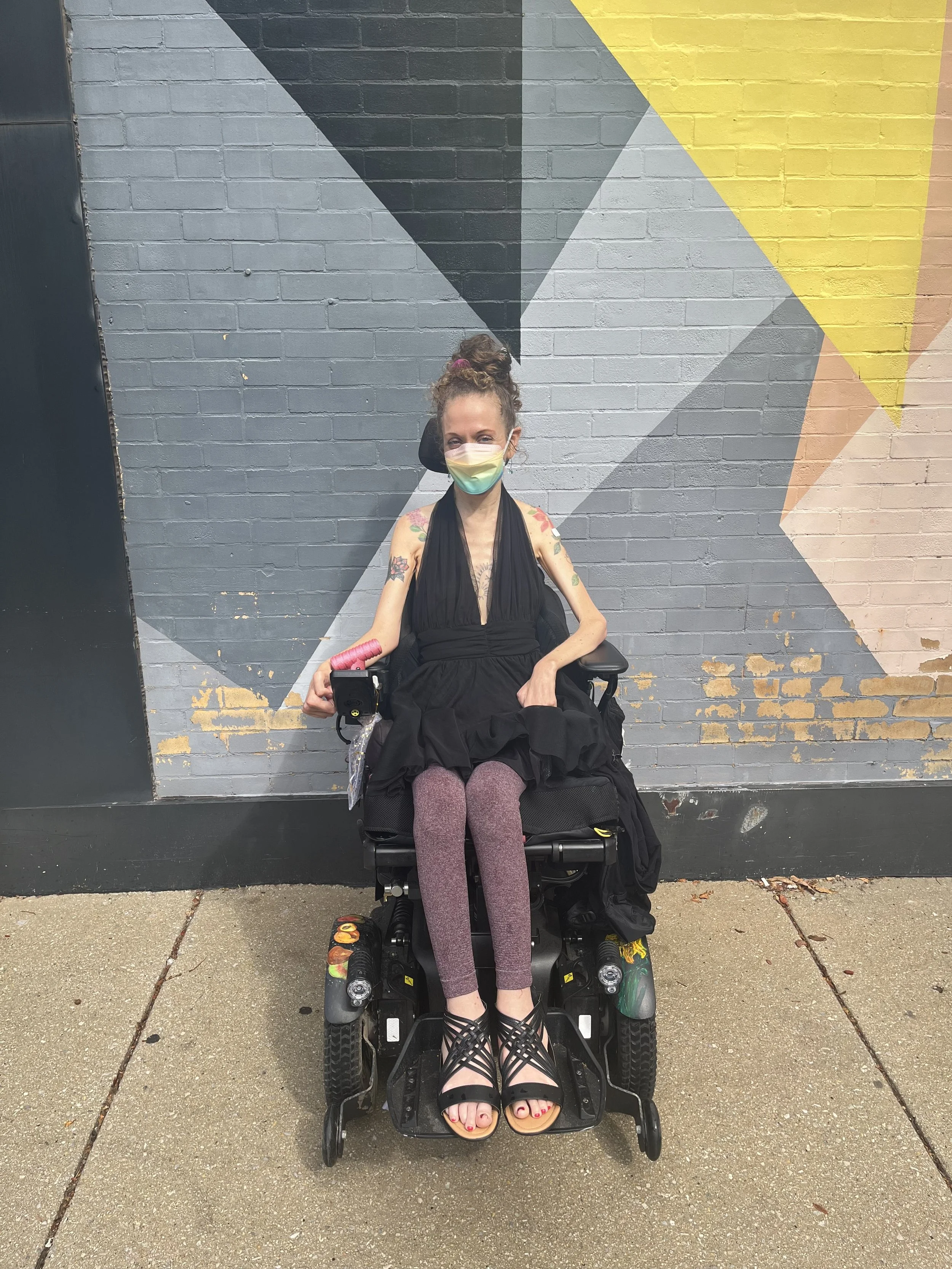
cherry is a queer, disabled, white, Jewish writer and kitchen witch. She lives in Chicago and is the creator of DisabledParts, a website exploring disabled sexuality and relationships. She is an ANTE-UP and AASECT certified sexuality educator, and a death doula who prioritizes creating spaces for other disabled survivors. She is an Aries with a Sagittarius rising and a cancer moon. She treasures deep and authentic relationships with friends, plants, and ancestors. Slice-of-life anime and nature documentaries are the things she watches when she needs to be soothed, and breakfast with tea is her favorite part of the day. Her work explores disabled embodiment, erotics, survivorship, feeding people, care, and intimacy as well as Jewish magic and spirituality.