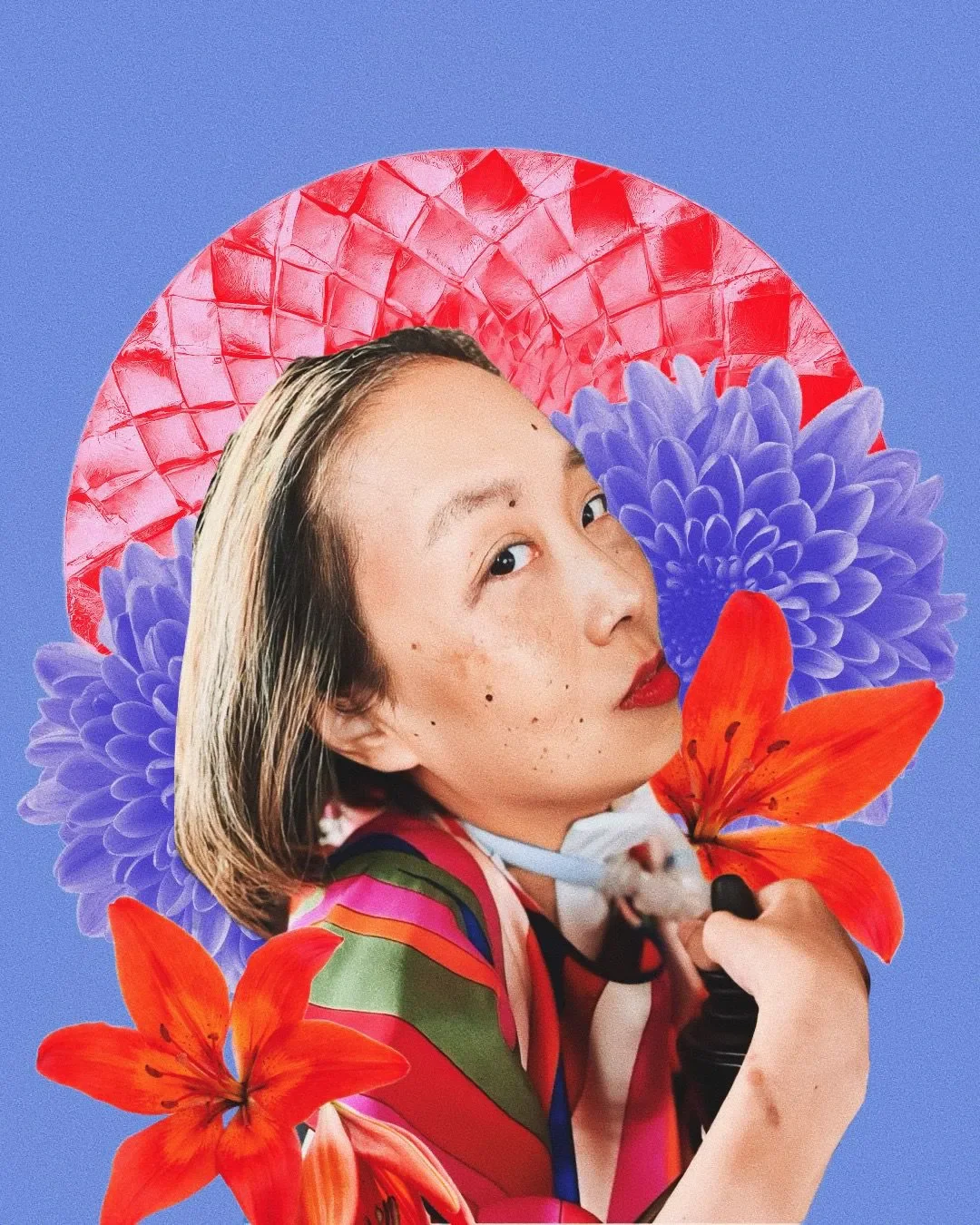
Digital portrait by Jen White-Johnson featuring a photo of Asian American woman with honey blonde hair. She is in a wheelchair and there is a tracheostomy at her neck connected to a ventilator. She is wearing a silky multicolored shirt and a bold red lip color. She is looking intently at the camera with the heat of a thousand suns. Behind her are red and purple flowers with a red circle in the background framing her face like a warm sun. The background of the portrait is purple.
By Kennedy Dawson Healy
Since 2020, disabled grief has, for the most part, felt too heavy for me to access. Yet, when Alice Wong died in November of last year, it found me again. She was 51 years old. I had the privilege of writing for her and looked up to her immensely, but did not know her well. Alice had a way of taking oppression, grief, death, and fear and making joy and life. I hope to do the same in honoring her here. Gathered from our short e-mail interactions, my exposure to her work, her social media presence, and the hundreds of posts and obituaries shared since her death, here’s what I know for sure…
Alice Wong was really, really cool.
Her fashion sense was cool. She was a WNBA fan – cool. She had a cool sense of humor. She wrote funny things and made funny faces in photos and sent funny messages.
Her grace was cool. She would engage with all kinds of people, extending an invitation into the work of disability justice. She gave all kinds of disabled people a platform. She talked to giant platforms and people who are considered important and actual important people that most people would not consider important. She spent so much of her life educating others about ableism. Me and my co-collaborator were nervous to pitch our photo project to her, so we asked a friend of mine to introduce us to Alice. She was immediately like “you could have just reached out to me.” She was always encouraging of my work and direct but kind.
She had cool work. She was a writer, editor, podcaster, activist, educator, speaker, consultant, cyborg, visionary, oracle, and so much more to the people close to her.
Her platform, Disability Visibility Project, has over 11 years of posts, 100 podcast episodes, interviews, and more.
She published 6 books highlighting her own and other disabled people’s stories. These include a 3 book anthology series made up of Disability Visibility, Disability Intimacy, and Disability Vulnerability (forthcoming). As well as her memoir, Year of the Tiger: An Activist’s Life.
She advised President Obama on disability issues as a member of the National Council on Disability from 2013-15. Her work on COVID, Medicaid, and her disabled reality is published in outlets like Teen Vogue, Vox, and The New York Times. She voiced a cartoon cameo of herself in Season 2 of the show Human Resources on Netflix, including an episode about disability and dating. She was a 2020 Disability Futures Fellow and a 2024 MacArthur Fellow.
I would imagine these accolades were as important to her as the community-based projects she was a part of. Examples of these include Access is Love, which reframes accessibility measures from a burden to an act of love. Society of Disabled Oracles, a collection of works of disabled wisdom. And, mostly recently, Disabled Rage, a graphics-based project centering disabled peoples’ anger at the current administration.
Alice’s work was an archive that preserved disabled realities and memories and fought for more just disabled futures.
Alice had cool politics. She asserted that disabled people had something important to say and to offer society that only we could offer. She engaged with disability rights and disability justice throughout her life. As an Asian American woman, she understood disability connects and intersects with other identities and movements. She refused death by oppression or disability over and over and resisted mass death with her work around COVID, the climate crisis, and Palestine (including but not limited to this syllabus and e-sims fundraiser). She showed people how to love disabled people, and understood what we owe each other. She demonstrated that through simple actions like encouraging people to wear masks.
She wrote a message to her followers before she died that her friend, Sandy Ho, posted to Alice’s Instagram upon her passing. It’s about her disabled life and disabled stories and what we deserve and the crip wisdom we offer. It’s about how she still had more stories to tell.
She ends with “don’t let the bastards grind you down” – a steep order right now. But one that Alice can make, because that’s how she lived.
So freaking cool.
Donations to Alice’s legacy fund can be made here. A public celebration of life will be live streamed on March 25, 2026, with details to come on Alice’s Instagram.
This piece was written by our founder, Kennedy Dawson Healy. Read more about her on our team page.